A major breach of the Kansas City, Kansas, Police Department reveals, for the first time, a list of alleged officer misconduct including dishonesty, sexual harassment, excessive force, and false arrest.
Hack Exposes Kansas City’s Secret Police Misconduct List
In 2011, after months of complaints from residents about the department’s SWAT team—broken TVs, missing cash, lost electronics, even a stolen pornographic video—the Kansas City, Kansas, Police Department launched an undercover sting with help from the FBI to root out the department’s lying and stealing cops. They called it Operation Sticky Fingers.
On January 6, Selective Crime Occurrence Reduction Enforcement Unit officers served a search warrant at a rented house, carefully staged with thousands of dollars’ worth of electronics, weed, and cash, unaware that the house was wired with hidden cameras embedded into an alarm clock and smoke detector, recording their every move. The ruse worked. Cameras captured three officers stealing video games, an Apple iPod, headphones, and $640 in cash. All three were fired and charged federally with conspiracy, deprivation of civil rights, and theft of government property.
According to his fellow officers, Gardner had a history of smashing TVs during raids, stealing video games, and even one time swiping a bag of crab legs. “You can’t catch me unless you catch me on video,” an officer told prosecutors that he recalled Gardner once saying.
With only the word of these three discredited officers, prosecutors declined to press charges. But in a memo to then-chief Rick Armstrong, the district attorney warned that any future police work involving Gardner—whether detective work, arrests, or testimony—should be viewed with deep suspicion. “It would be highly unlikely we would file a case that is based in significant part on his testimony,” the memo concluded.
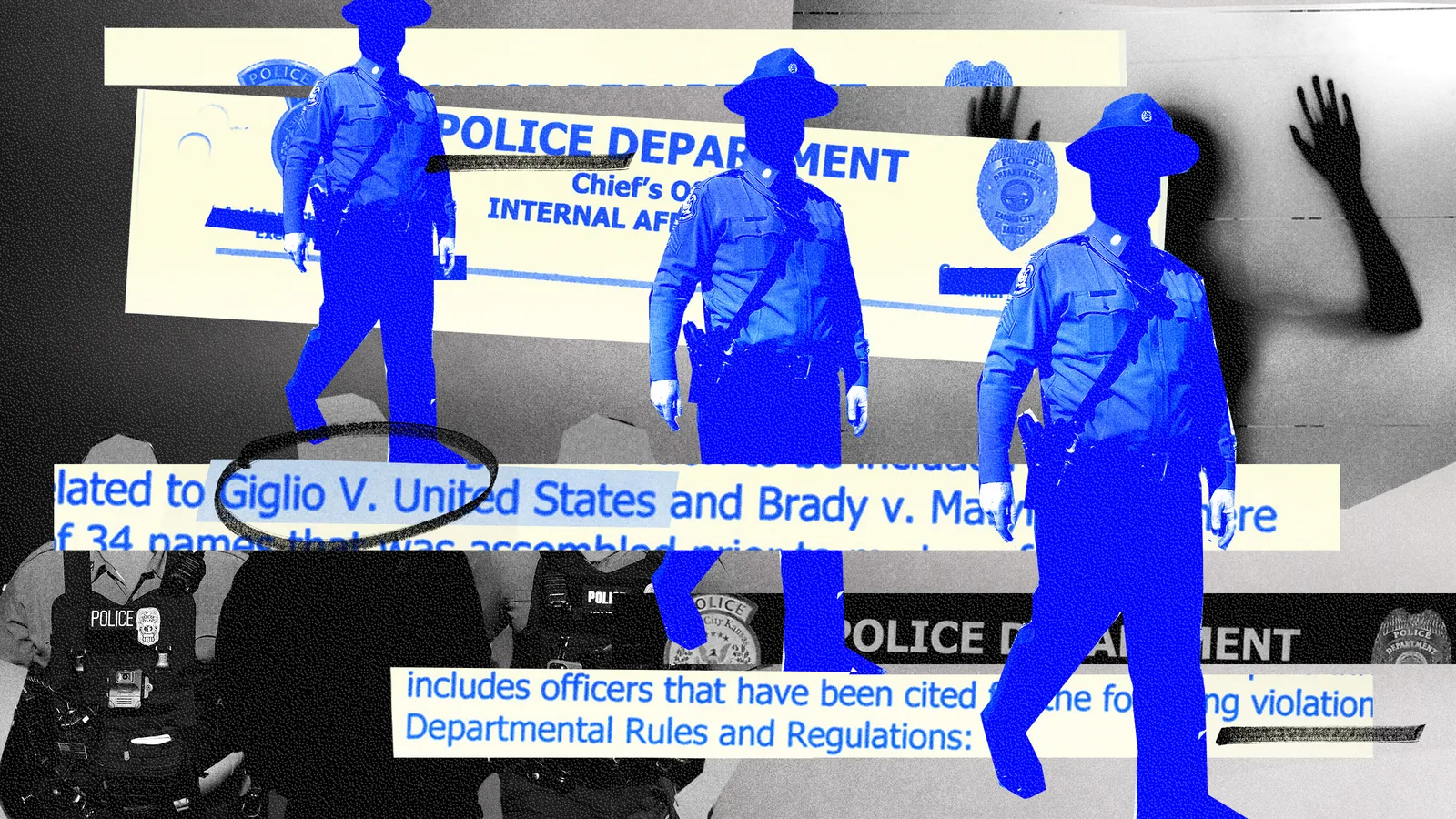
The memo placed Gardner on the department’s highly secret Veracity Disclosure List, commonly known as a Giglio List, which refers to Giglio v. United States, a 1972 decision which established that the prosecution must disclose any information that might question the credibility of its witnesses. In KCKPD’s case, this is a roster of officers whose credibility may be so compromised that the department believes their involvement in criminal cases, whether through testimony, arrests, or investigative work, could jeopardize prosecutions.
Nevertheless, 15 years later, Gardner still works at KCKPD. He is among 62 current and former officers who engaged in misconduct so damaging to their credibility that, if called to testify, it may need to be reported to the courts.
Gardner did not respond to a request for comment.
Documents exposed in a major hack of the Kansas City, Kansas, Police Department, reviewed by WIRED and KCUR, reveal the department’s Giglio List for the first time, along with dramatic details of the misconduct that put officers on it, from incompetence to domestic violence. Published by the transparency nonprofit Distributed Denial of Secrets, more than 1 terabyte of hacked documents paint a disturbing picture: Officers with egregious credibility issues—those the department itself investigated and found untrustworthy—were not only allowed to stay on the force but often rose through the ranks or moved on to other departments, without the public knowing.
KCUR and WIRED corroborated the Giglio List found in the hack with testimony from the then-Wyandotte County district attorney in a 2011 case. The full context of what landed a particular officer on the list was not always evident.
The files are a further indication of what has been an open secret for decades—residents’ accusations that many KCKPD officers were corrupt or racist—and were made very public with the 2022 arrest of Roger Golubski, a retired KCKPD detective accused in two federal cases for allegedly sexually assaulting at least seven women while on duty and protecting a drug dealer’s sex trafficking ring. Golubski told his roommate at the time that he’d rather “eat my gun” than go to jail. He died of an apparent suicide on December 2, 2024, on the first day of his federal court trial.
Golubski’s file also highlights a broader flaw in the Giglio List and the department’s internal misconduct investigations: whether these records accurately reflect an officer’s complete history of misconduct. In Golubski’s case, the file cites only a single incident from the 1970s and makes no mention of the numerous allegations he would later face. That omission lends credibility to the criticism from KCKPD watchdogs who argue that department leadership knew about Golubski’s actions for decades—and covered it up.
When shown the list of officers included in the hack, retired KCKPD detective Max Seifert was surprised to see some officers’ names on the list whom he considered good cops, while leaving off officers who had flagrant misconduct but were intentionally protected by higher-ups.
“There are names that should be on that list, that I felt were worthy of criminal prosecution or deserved to be criminally prosecuted,” said Seifert, who worked with Golubski for 31 years before, he says, he was forced into retirement. He later sued the Unified Government, which runs Wyandotte County and Kansas City, Kansas, alleging retaliation for speaking out about the police beating of a motorist.
“To me that’s an injustice to the officers that are good, and it speaks to some of the things going on in the department that some of the names were left off,” Seifert said.
The alleged misconduct cited in the hacked files also varies widely, ranging from relatively minor violations like time theft to major sins like having a sexual relationship with a confidential informant.
Ultimately, the department’s Giglio List is critically important because it directly affects criminal cases. An officer’s credibility is on the line at trial, and any past offenses, if turned over to the defense by a prosecutor, can impeach the officer and harm a prosecution. If the misconduct on a Giglio List is a major offense, like excessive force, racial profiling, or evidence tampering, prosecutors simply refuse to let officers testify, said Stephen McAllister, a former US Attorney in Kansas who is now a University of Kansas law professor.
“Officers don’t like it, and understandably, because when you get on the Giglio List, if it gets bad enough, then no prosecutor is going to want to use you as a witness, and the police department may decide they really don’t have a use for you,” McAllister said.

Secret Police (Files)
Last year, the ransomware gang BlackSuit published the police files after the Kansas City, Kansas, Police Department reportedly refused to pay a ransom. The breach was part of a growing trend of law enforcement and other government agencies being targeted by ransomware groups. In 2021, for instance, another ransomware group called Babuk hacked the Washington, DC, Metropolitan Police Department, stealing 250 gigabytes of sensitive data. A joint investigation by the Center for Investigative Reporting and WAMU/DCist later reported that the records showed that MPD had tried to fire at least 24 officers for criminal misconduct—but high-ranking officials, including the then-police chief, intervened to keep them on the force.
The KCKPD breach is even more extensive than the DC police leak, which were also published by DDOSecrets. The hacked files contained over a terabyte of records spanning decades, including operational plans for law enforcement raids, human resources data on overtime payments, internal affairs databases, and more.
According to Johann Drolshagen, CEO of Equal Playing Field Solutions and founder of a nationwide, publicly accessible database that tracks misconduct by police officers, prosecutors, and judges, the Giglio List is best understood from the perspective of a juror. “If you’re a juror,” he said, “you’re being asked to make a serious decision—one that could send someone to prison for life. You have to be sure, beyond a reasonable doubt, that the person is guilty. But if you can’t trust the person giving you the information—like the officer testifying—how are you supposed to do your job?”
The records show that officers included on the list were cited for filing false reports, stealing during traffic stops, or general incompetence. One officer was added after allegedly posting a crime-scene photo of a suicide on Facebook; another was arrested for disorderly conduct while off duty in an incident where he reportedly pushed a police horse.
Police misconduct investigations like this are often shielded from public view, with departments frequently citing privacy laws to deny access to internal records. In 2017, the Los Angeles County Sheriff’s Department secretly investigated a Los Angeles Times reporter for at least three years after she published a story based on a leaked list of roughly 300 problem deputies. In Kansas City, Kansas, the police department asserts that Giglio Lists are not subject to disclosure, as they considered confidential personnel records.
While prosecutors are legally obligated to disclose Giglio material to the defense, it’s often difficult to know whether they’re actually fulfilling that responsibility. Public defenders have long argued that prosecutors routinely withhold exculpatory evidence. Prosecutors, in turn, claim that police departments don’t always share that information with them—making it hard to disclose what they don’t know exists.
Nevertheless, violating the Giglio rule can carry serious consequences. If a violation is uncovered during trial, a judge can declare a mistrial or bar prosecutors from using evidence tainted by the withheld information. More often, though, evidence of officer misconduct surfaces after a conviction—fueling appeals that seek to overturn guilty verdicts. That’s what happened in Chicago, where misconduct by officer Ronald Watts led to dozens of exonerations—including 15 men whose convictions were thrown out after they said Watts framed them for refusing to pay him off.
In the case of KCKPD, it remains unclear how many officers on the Giglio List testified in criminal trials or how many convictions may have relied on their testimony. In response to detailed questions and a request for comment, Jonathan Carter, public information officer for the Wyandotte County District Attorney’s Office, wrote in an email that defense attorneys are given information about Giglio officers “on a case-by-case basis” and that it’s up to law enforcement to provide information about officers with Giglio issues. “If the District Attorney’s Office believes an officer has veracity issues,” he wrote, “we will not call that officer to the stand in a criminal case.”