Lawmakers split on president’s actions as constitutional debate intensifies.
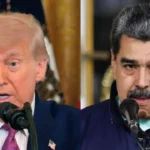
Trump’s Venezuela strike sparks constitutional clash as Maduro is hauled into US
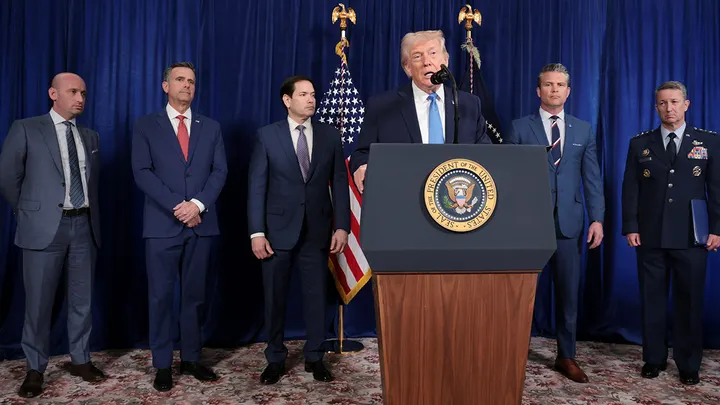
The Trump administration’s stunning overnight operation in Venezuela Saturday involving at least seven military strikes and the capture of Nicolás Maduro drew familiar legal criticisms from across the political spectrum.
President Donald Trump’s decision to authorize the strikes, which early reports say killed dozens of foreign military and law enforcement personnel, follows decades of presidents sidestepping Congress to launch offensives abroad. But experts and lawmakers warned that the legal questions do not end there.
While Maduro and his wife are detained in New York and face prosecution for alleged narco-terrorism conspiracy, cocaine importation and weapons charges, Trump has said the U.S. incursion in the South American country was about more than Maduro’s capture. Trump said the U.S. plans to take over Venezuela and exploit its enormous oil reserves, a sweeping vow that raised a bevy of concerns among Democrats and non-interventionist Republicans.
DEFIANT MADURO DECLARES HE IS A ‘PRISONER OF WAR’ IN FIRST US COURT APPEARANCE
Clark Neily, a senior vice president at the CATO Institute, a libertarian think tank, told Fox News Digital that Trump’s decision to carry out Maduro’s arrest tested constitutional limits but was likely legal. Neily said, though, that the president’s subsequent suggestions of regime change in a sovereign nation were more problematic.
“When a decision is made to entangle the United States in that kind of situation – and, there’s also been talk by Trump of putting boots on the ground, so that could involve the commitment of substantial military resources and potentially put the lives of our service members on the line – that’s really the kind of decision that I believe the Constitution commits to the Congress and not to the unilateral discretion of a president,” Neily said.
Congress has the sole power to declare war, but presidents have long used military force without formal congressional approval. Neily said a top historical comparison could be drawn from former President George H.W. Bush’s invasion of Panama in 1989, in which the president authorized a military operation that resulted in Manuel Noriega’s removal from power and prosecution and conviction in the U.S.
Sen. Mike Lee, R-Utah, indicated on Saturday that the operation in Venezuela was a narrow move intended to protect those executing an arrest warrant. He said Trump’s unilateral approval of it was likely protected under Article II of the Constitution, which governs executive branch authority.
“This action likely falls within the president’s inherent authority under Article II of the Constitution to protect U.S. personnel from an actual or imminent attack,” Lee said.
But Sen. Tim Kaine, D-Va., called Trump’s actions “illegal” and said opposing lawmakers plan to use the “power of the purse” to counter them.
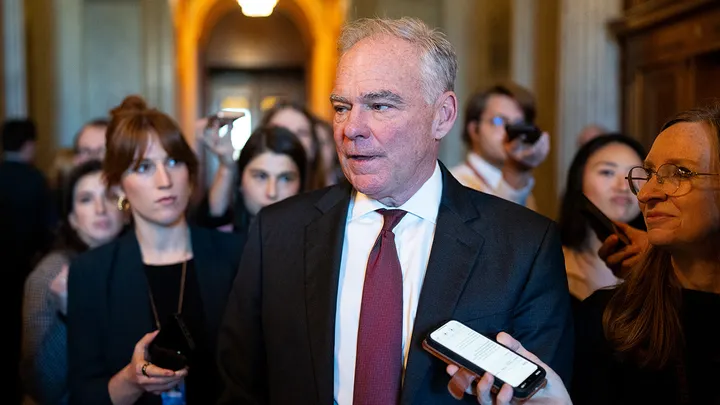
“There are two levers that we intend to use,” Kaine said.
He pointed to a war powers resolution, whose cosponsors include Sen. Rand Paul, R-Ky., and Senate Minority Leader Chuck Schumer, D-N.Y., that senators intend to soon bring up for a vote to block further military action in Venezuela. A similar resolution narrowly failed, largely along party lines, following Trump’s strikes on Iranian nuclear facilities last year. Kaine also threatened to withhold funding for Venezuela from the defense appropriations bill, which needs to be resolved by the end of January.
Kaine noted that Trump “ushered in this particular wingnut to run Venezuela,” referring to Delcy Rodriguez, No. 2 to Maduro, and predicted Rodriguez would not be a cooperative partner to the U.S. The president said in an interview with The Atlantic that if Rodriguez did not “do what’s right” she would “pay a very big price, probably bigger than Maduro.”
Concerns about the U.S. role in Venezuelan affairs escalated after Trump said following Maduro’s capture that the U.S. would remain involved and could not rule out further military action.
“We’re going to be running [Venezuela] with a group, and we’re going to make sure it’s run properly,” Trump said.
Trump said the “people that are standing right behind me” are going to oversee the transition, a reference to Secretary of State Marco Rubio, Secretary of War Pete Hegseth and Chairman of the Joint Chiefs of Staff Dan Caine, among others.