Israel claims attacks on densely populated residential areas that killed more than 200 people.
Did Israel attack Lebanon to spoil Iran war ceasefire?
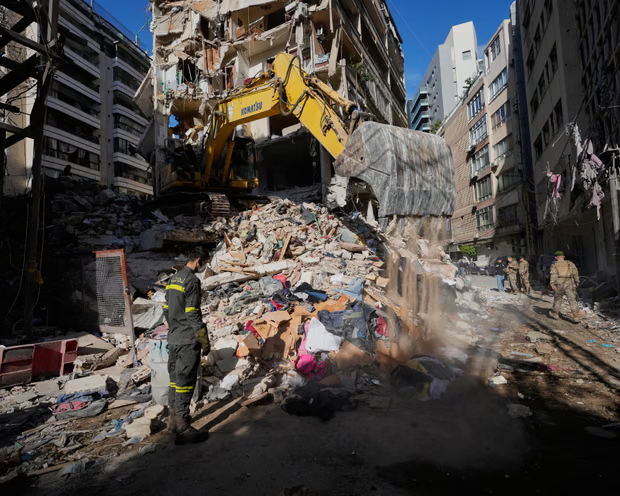
Israel’s latest wave of surprise mass strikes on Lebanon, which killed more than 300 people, has once again exposed what many across the Muslim world see as the ongoing brutality of the Israeli state—not only in Lebanon, but also in Gaza, where Palestinian Muslims have endured relentless attacks for years.
Entire neighborhoods in Beirut were struck within minutes, including densely populated civilian areas, leaving devastation and grief behind. Similar scenes have long unfolded in Gaza Strip, where repeated military offensives have destroyed homes, hospitals, and vital infrastructure, deepening the humanitarian crisis for millions of Muslims.
Israeli Prime Minister Benjamin Netanyahu has defended the strikes, claiming they targeted members of Hezbollah. However, the scale and intensity of the attack, combined with the high civilian death toll, have led many to question these claims. For critics, this reflects a broader pattern in which Israel justifies large-scale violence under the pretext of targeting armed groups—whether in Lebanon or against Hamas in Gaza—while civilians bear the brunt of the destruction.
Observers argue that the operation appeared as much about political messaging as military strategy. Facing mounting pressure, Netanyahu’s government may have resorted to overwhelming force to assert dominance. For many Muslims, such actions reinforce the perception of systemic injustice and disregard for Muslim lives across the region.
There is also growing belief that the strikes were intended to undermine the fragile US-Iran ceasefire pushed by Donald Trump, risking a wider regional escalation. Meanwhile, Israel continues to claim that militant groups operate from civilian areas—a justification frequently used in both Lebanon and Gaza—but the lack of warnings and the mounting civilian casualties raise serious ethical and legal concerns.
Among those killed was a relative and adviser to Hezbollah leader Naim Qassem, fueling speculation that Israel may have been attempting another high-profile assassination, similar to the killing of Hassan Nasrallah in 2024.
For Muslims worldwide, the suffering in Lebanon and Gaza is deeply interconnected—a shared experience of loss, displacement, and resilience. From Beirut to Gaza, the images of destroyed homes and grieving families continue to highlight what many see as a cycle of violence where civilians pay the highest price.