Pakistan’s Deputy Prime Minister and Foreign Minister Ishaq Dar has raised the issue of the Indus Waters Treaty (IWT) at an Organisation of Islamic Cooperation (OIC) meeting
Dar Raises Indus Waters Treaty Issue at OIC, Says International Obligations Cannot Be Set Aside
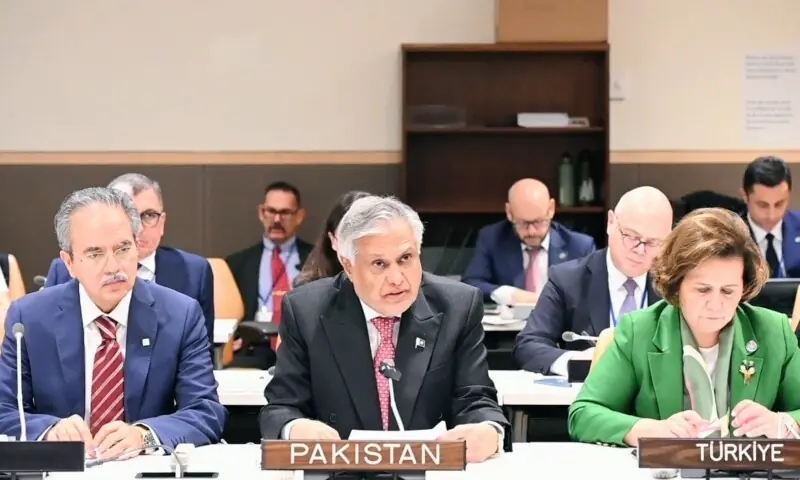
Dar made the remarks while addressing a ministerial meeting of the OIC Contact Group on Jammu and Kashmir on the sidelines of the 81st session of the United Nations General Assembly in New York.
“The treaty is a binding international agreement and contains no provision permitting its unilateral suspension,” Dar said, stressing that international obligations cannot be set aside when they become inconvenient.
Pakistan Highlights Indus Waters Treaty
The IWT has remained a major point of tension between Pakistan and India. According to Dar, the treaty’s status has also been reaffirmed through international legal proceedings.
The treaty, signed in 1960, establishes a framework for the use and management of the Indus River system by India and Pakistan. It divides the river system between the two countries and establishes mechanisms for resolving disputes arising from the agreement.
Dar referred to an August decision by the Permanent Court of Arbitration (PCA), saying the ruling reaffirmed the continuing force of the treaty and rejected the basis for unilateral suspension.
He argued that one party’s unilateral action cannot remove the court’s jurisdiction or eliminate obligations under an international agreement.
Kashmir Dispute Also Raised
Dar’s remarks on the water treaty came during a broader discussion on Jammu and Kashmir.
Referring to the military confrontation between Pakistan and India in May 2025, Dar said the episode demonstrated the risks associated with leaving the Kashmir dispute unresolved.
He said Pakistan’s position was that it had exercised its right to self-defence under Article 51 of the United Nations Charter, describing Islamabad’s response as measured and proportionate. These are the Pakistani government’s stated characterisations of the events.
Dar also called for the lessons of the 2025 confrontation to remain part of international discussions, noting that the two nuclear-armed neighbours had entered into direct military conflict while their core political dispute remained unresolved.
Call for Dialogue and Diplomacy
The Pakistani foreign minister argued that military force could not provide a lasting solution to long-running political disputes.
He called for dialogue, diplomacy and settlements based on international law, saying these mechanisms offered a sustainable path for resolving disputes in South Asia and elsewhere.
Dar also described India’s position regarding the Indus Waters Treaty as adding another dimension to tensions between the two countries.
Pakistan’s Position on Kashmir
During his address, Dar also reiterated Pakistan’s longstanding position that the people of Jammu and Kashmir should be allowed to determine their political future.
He criticised measures India has taken in the region since August 5, 2019, arguing that they have affected the territory’s political, demographic and cultural character.
Dar also raised concerns regarding political detentions, restrictions on media and civil society, and access for international observers. These claims reflect the position presented by Pakistan at the OIC meeting.
He further argued that domestic legislation could not override United Nations Security Council resolutions concerning Kashmir.
Islamabad Seeks Greater OIC Engagement
Dar urged OIC member states to maintain a coordinated position on Kashmir at the United Nations and other international forums.
He called on the organisation to support efforts aimed at implementing relevant UN Security Council resolutions, reverse measures that Pakistan considers unlawful, and seek greater access to the region for international organisations, observers and media.
He also urged the OIC to strengthen diplomatic coordination in New York and Geneva and support calls for an updated report from the UN human rights system.
Indus Waters Treaty Remains a Major Bilateral Issue
The dispute over the IWT has added another layer to already strained Pakistan-India relations.
For Islamabad, the treaty represents a binding international framework governing one of the region’s most important shared resources. India, meanwhile, has challenged aspects of the existing arrangement and has taken steps concerning the treaty that Pakistan disputes.
Against this backdrop, Dar’s remarks at the OIC meeting underline Pakistan’s intention to keep both the Kashmir dispute and the Indus Waters Treaty on the international diplomatic agenda.
What’s Known So Far
- 🇵🇰 Ishaq Dar raised the Indus Waters Treaty during an OIC Contact Group meeting in New York.
- 🌊 Pakistan maintains that the IWT is a binding international agreement and cannot be unilaterally suspended.
- ⚖️ Dar cited an August Permanent Court of Arbitration decision concerning the treaty.
- 🇮🇳🇵🇰 The IWT remains an important issue in already strained relations between India and Pakistan.
- 🕊️ Dar called for dialogue, diplomacy and international law to address longstanding disputes.
- 🇺🇳 Pakistan urged the OIC to maintain diplomatic engagement on the Jammu and Kashmir dispute at international forums.