Taiwan should transform itself into a “hornet’s nest” of unmanned aerial systems capable of overwhelming any potential invading force.
Taiwan Should Become a ‘Hornet’s Nest’ of Drones to Deter Threats
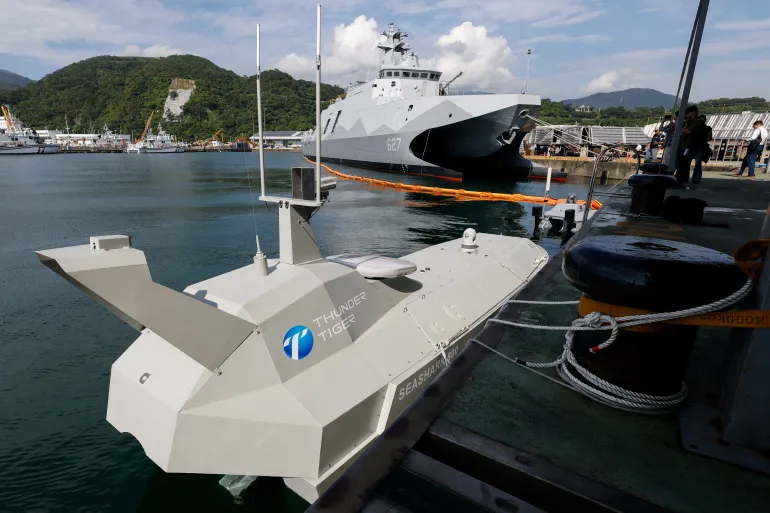
Speaking about regional security challenges, Raymond Greene, the director of the American Institute in Taiwan—the United States’ de facto embassy—said that drones offer a “game-changing opportunity” for strengthening Taiwan’s military capabilities amid growing tensions across the Taiwan Strait.
Greene emphasized that Taiwan’s security increasingly depends on adopting innovative and cost-effective technologies that can deter aggression. He argued that swarms of advanced drones could significantly complicate any military operation aimed at the island by making it far more difficult and costly for an adversary to launch an invasion.
The remarks come as Taiwan continues to modernize its armed forces in response to increasing military pressure from China, which considers the self-governing island part of its territory and has not ruled out the use of force to bring it under Beijing’s control.
Drone Strategy Gains Momentum
Military analysts have increasingly promoted what is known as the “porcupine strategy,” which focuses on equipping Taiwan with large numbers of highly mobile, affordable, and difficult-to-destroy defensive systems rather than relying solely on expensive conventional weapons.
Greene said drones fit perfectly within this concept, allowing Taiwan to build a resilient defense network capable of surveillance, reconnaissance, electronic warfare, and precision strikes. Large fleets of unmanned systems could monitor coastal areas, track hostile movements, and rapidly respond to threats while reducing risks to military personnel.
He described the technology as an opportunity to reshape Taiwan’s defense posture, noting that lessons learned from recent conflicts around the world have demonstrated the growing importance of unmanned aerial systems on modern battlefields.
Lessons From Modern Warfare
The rapid evolution of drone warfare has attracted global attention after conflicts in Eastern Europe and the Middle East showcased how relatively inexpensive unmanned aircraft can destroy armored vehicles, disrupt supply lines, gather intelligence, and overwhelm sophisticated air defense systems.
These developments have prompted many governments to accelerate investments in domestic drone manufacturing and artificial intelligence-enabled autonomous systems.
Taiwan has similarly expanded efforts to develop a strong local drone industry, aiming to reduce dependence on foreign suppliers while increasing production capacity for military and civilian applications.
Growing US Support
Washington has repeatedly reaffirmed its commitment to helping Taiwan maintain a sufficient self-defense capability under longstanding US policy. Although the United States does not maintain formal diplomatic relations with Taiwan, it remains the island’s most important international security partner and principal supplier of defensive weapons.
US officials have encouraged Taiwan to prioritize asymmetric warfare capabilities, including anti-ship missiles, coastal defense systems, mines, and unmanned platforms that could slow or repel a larger military force.
Greene’s comments reinforce this approach, highlighting drones as one of the most effective tools available to strengthen deterrence without requiring massive increases in conventional military spending.
Rising Cross-Strait Tensions
Relations between Beijing and Taipei remain strained as China continues to conduct frequent military exercises, naval patrols, and air operations near Taiwan. Chinese officials insist that reunification with Taiwan is inevitable and have warned against what they describe as foreign interference in the issue.
Taiwan’s government, meanwhile, maintains that only the island’s people can determine their future and has pledged to continue strengthening national defense while expanding cooperation with democratic partners.
As unmanned technologies continue to redefine modern warfare, Greene argued that Taiwan has an opportunity to build a formidable drone force capable of deterring aggression and enhancing regional stability. His vision of turning the island into a “hornet’s nest” of drones reflects a broader shift toward asymmetric defense strategies designed to make any potential attack prohibitively difficult and costly.